Metal Contraband’s Chelsea spoke with Emily Lazar, aka September Mourning, on everything from her latest singles, to state of the music industry, to the project’s origins and expansion into a live music experience, comic book, and more. Check it out below:
Chelsea here on the phone with Emily Lazar, aka September Mourning. How are you doing today?
I’m good. How are you doing?
Good, thanks. Excited to talk with you about all the latest goings-on with your project, and thank you so much for joining me.
Yeah, of course.
So let’s kick things off right away with the latest releases from September Mourning. It all started with the single “I Surrender” earlier this year, and then more recently you had a cover of “You Oughta Know.” So tell us what brought about these two singles this year?
Well, “I Surrender” was an interesting one because it’s based in EDM, so it’s a little bit different, off the beaten path. It was meant to be kind of like the last on that album, the last single, and we just wanted to mix it up a little bit. I think that EDM has been very prevalent in our music culture, more modern. I love the feeling that it gives you and the electronics that go into it, the more modern electronic feeling. So we wanted to do something that had a taste of that, but still brought rock into it and a heaviness. So that’s where that came from.
Awesome, that definitely is becoming a more common juncture: EDM with rock, with metal. Everyone is recognizing what you just said, that prevalence of the culture, how everyone is really into that, and crossing it over into different genres, which is fun to experiment with, too.
Yeah, I think that the rise of streaming has brought our listening palette into a different place, so I think that people…it used to be very conditional, like people were in sort of sub-sects of music culture, but now because of streaming, everybody’s kind of all over the place. So you listen to one track of EDM, you listen to one track of metal, you listen to one track of pop, you listen to one track of hip-hop. Like, that’s your list, your playlist. It’s not just metal – it can be – but more often than not, I find that a lot of people have a varied musical palette now, which I like. So I think because of that, different genres are bleeding into each other, and they’re experimenting more with different sounds, and I love that. I think that a mishmash is kind of fun.
Definitely, no, I love that insight. Actually, that’s such a great take on it in terms of streaming really being the thing to kind of push into crossing over genres, because, in a way, it comes down to the technology and the algorithm that almost forces things into people’s playlists once in a while, like, “Hey, you should listen to this,” in the flow of the music you’re ordinarily listening to. And not “forces” in a bad way, but it kind of expands, like you said, the listening palette, where something they would never click on is now just dropped right in front of them, so that’s a really interesting take. I like that.
Yeah, I mean, it’s just kind of how technology is affecting us at a base level, you know? And especially in the arts, I think it’s really interesting what’s happening, and even AI music and all that rising up. Not that I’m a huge fan of everything completely AI, but we have been using AI to quantize drums as long as I’ve been in the industry, and even doing vocals, like VocAlign and just make sure that everything is on key using Melodyne, and things like that. That’s always been part of my workflow as a vocalist, so I’ve never known anything prior to that, and that’s all kind of from the basis of the same AI tech we’re experiencing now, but now on a different level. So it’s just interesting how tech is really affecting music in general.
No, you’re absolutely right, because a lot of elements of audio production in the past couple of decades, really, have been everything from quantizing drums, to the Auto-Tune concept and everything. We weren’t calling it AI, per se, these were just techniques, and plugins for DAWs. “We’re using plugins”, “we’re using effects”, and things like that. Nobody was really calling it AI, but now that AI is this kind of umbrella term that’s just covering everything that’s happening in technology nowadays, a lot of people are separating those elements out and being like, “Oh, well, we don’t want AI involved in the music,” but you’re so right. Things like that have been done for a while, we just weren’t calling it AI, per se.
Exactly, and the scope of it wasn’t as broad, and it wasn’t as easy to do. Back when we were doing music, when I first started music, I could not do vocal lining, and I didn’t have the skill set to do that. But now you don’t have to have any skill set. All you have to do is put in a prompt: “I want it to sound like Pierce the Veil,” and then you get a song that sounds like Pierce the Veil. *laughs* So that’s the skill set is that you need to be able to speak. f you can speak, now you can make music. *laughs* So the bar is on the floor now. It’s literally on the floor, which I think is really debilitating to a lot of artists because it’s kind of like, we spent our whole entire adult lives cultivating these skills to make this music, and now it’s kind of like, you don’t need them anymore. Remember The Matrix? That’s one of my favorite movies, but it reminds me of The Matrix, when Neo goes into the chair and they plug him in, and they teach him karate by just plugging it into his brain? Dude, I feel like that’s what AI is. It’s like our plug-in, and we just speak to it, and it does it for us. So people feel that makes them a musician now, but no, you’re not, you just can navigate an artificial intelligence that can do the work for you. That’s a totally different thing than actually having the skill set.
Exactly, it’s definitely a wild change, but I feel like that just makes the “human-made” music all the more important, because it is still pretty easy to spot AI. I feel like I notice when those AI songs are coming out, people are immediately just jumping on it, like, “AI”, “AI, We can tell” so far.
Yeah, I mean, there definitely is a sort of sound that kind of comes with that. I think that people are kind of understanding the slop at point, maybe not the general listener, but I think that people that really love music kind of get it, and I do think that the human-to-human thing, that is a huge market right now: human-made music, human-to-human contact, and emotion. That emotional intelligence is very, very big right now, and it needs to be leaned into, because I think that we’ve had a problem in the music industry where bands and artists, their accounts are bot-ed, and you think they’re bigger than they are. So there isn’t a human-to-human element, and then you’ll go to a show and they don’t even draw people because all their accounts have been bot-ed. There’s no human element there. So I think that bringing back the humanity of everything is really important, because then it becomes its own little lane that can be propagated and actually something real, and I mean, that’s when you can actually make a career, right? When you’re actually there with your fans, they understand you, they support you on a real level. That human-to-human contact is, to me, undeniable, and you can’t put a price tag on that.
One hundred percent, and I do think that’s something we see with you in September Mourning, because you have such a unique artistic take, and you’re taking these elements of music, visuals, aesthetics, and even comic books. I mean, did you ever imagine growing up that you’d become a comic book character?
I mean, no, but I always loved comic books, you know? So I think that it’s really funny. I think this has been said by some psychologists and some people for a very long time, but you kind of become what you love from being a little kid. Everything you loved as a little kid, you kind of become when you become an adult. Those things stay with you. They’re very hardwired into your psyche. So I think that they drive a lot of your choices as an adult. And I really do believe that. So growing up, I loved comic books. So for me to actually wrap something this big around a whole comic book and graphic novel and multiple books is…I mean, of course I was gonna do that. You know what I’m saying?
Yeah, of course. Making your childhood dreams come true, too, which is lovely.
Yeah, exactly. I think we all kind of try to do that. We all have these little kids in us that we’re just trying to satiate. That’s literally why we’re here. We’re trying to make those things happen for that little kid that our parents never got to make happen, or we never felt loved from, or something like that. So we’re trying to bridge those gaps consistently as an adult, and it’s really funny. If you really look into your psyche, you’re like, “Oh, crap, that’s literally what I wanted as a kid. And now I’m doing it.” You know.
That’s awesome. I’m very happy for you that you do get to express yourself in that way as well. So, tell me a little bit more about the art and the visuals of September Mourning. What was your inspiration for the look and aesthetic, or is it more something that developed over time as you were developing the project?
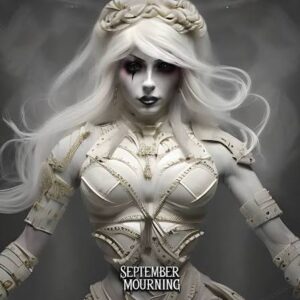
Well, September Mourning, it definitely came from a lot of different places. I mean, like I just said, I was obsessed with different things when I was growing up. Japanese culture was one of them, and the way the warriors looked, like how their gear was done, and even ancient Roman culture with how the gear was put together. I really loved that aesthetic even growing up, so I think that when I came to make September Mourning into this visual aspect and design the costume, it was always a warrior costume. And then, of course, what I loved before kicked in, and that Japanese sort of aesthetic combined with an ancient Roman aesthetic, and she has plates and armor, and it just became that. It all kind of found its way into this costume design, and that’s where I came from. I wanted to do something as a musical artist, as a female musical artist, that wasn’t a typical “you’re a hot girl in a band,” right? And a lot of people in the industry were like, “You’re really pretty, why don’t you just go up there and sing? Why are you wearing this makeup, and why are you in this armor and covered up?” And I was like, because there is something sexy about being this female warrior. There’s something attractive about being a strong female and not having to put it all out there, not having to rely on a typical aesthetic to convey sexuality. So I think that’s where that all came from.
That’s definitely a good take as well, and especially when you’re layering in storylines, a characterization, and it becomes a whole persona, that just increases the interest from ‘Wow, that’s such a striking visual’. Then you start digging into it, and you’re like, ‘And there’s a whole storyline following it, and a whole background, a whole character profile that’s been created around this as well’.
Yeah, there’s a whole story bible about her just in general. I wrote a 25-page doc of just where she came from, what she does, why she does it. The why, the why, it’s always about the why when you’re doing worldbuilding. It’s about why something exists, why it’s here, why now, why this, why that. You have to answer those questions so you understand your character.
I love that, and I also like that there are rock artists who have had a separate “persona” in that sense, like, you become this character, but it does tend to be grouped a lot into shock rock. You look at someone like Alice Cooper, he’s more designated “shock rock”, and then there’s bands that go with an extreme aesthetic, like GWAR, and while that’s technically metal, shock rock is a term that people use a lot whenever they see, “Oh, that’s an unusual visual”. So I like that you have not necessarily been put into that category because you’re doing so much genre-wise. You’re blending metal, rock, industrial, there’s even a little pop spun in there sometimes, even an occasional hip-hop edge, and the way that the genres meet has been great for you in carving your path and not falling into a specific genre or category that people might want to put it in.
Yeah, we wanted to world-build something outside of what has already been done, so I didn’t want to be another Alice Cooper, Marilyn Manson, or this, or that, the third, because those characters are deeply rooted in themselves. And although September Mourning, I mean, there are parts of me, of course, in her, but it’s not really deeply rooted in me. It’s another character that I’m portraying, almost like an actor. So it’s a totally different aesthetic, and on top of it, it’s a totally different way of approaching a character that you’ve built a world around through a comic book series. So it’s almost like if Harry Potter was done as a rock band, what would it be? It’s kind of like that. I hadn’t seen that before. I’d seen albums that had storylines, or I’d seen bands that had comic books put on them after they got big, or even Coheed and Cambria was great, and they had very specific songs for their stories, but they were just dudes on stage, kind of playing music. And Dethklok was kind of the same thing, although they had the cartoon in the background, but it was still, they were just guys up there playing music. They weren’t really playing the characters, per se; they were just kind of narrating it almost themselves. And I think that’s cool, but that’s not what I wanted to do. I wanted to encompass everything. I think the closest that came to it was the Gorillaz, but the Gorillaz never were the people on stage. They had these animated characters that did everything for them. So they never took the characters as themselves. I think there was something special about that sort of way of doing it from the jump, and not just putting it upon it as it got bigger. I think that when you start at the core with something, and you continue to be devoted to it, that gives it a stronger base, and everything grows off of that, and it is a stronger tree, you know?
I love that you’re doing a wonderful job of creating this world, embodying this world, and continuing to create new things out of it as well, which is very exciting. I also love your take on covers, because the recent single, for “You Oughta Know”, it really feels to me like what a cover should be, putting your own truly unique spin on it where it feels – when you listen, at first – like you’re listening to a completely new and different song altogether. But then you start picking up on the lyrics and you’re realizing, “okay, it is that original song”, but it’s just so transformed that it’s a new experience. And I love that approach to a cover as opposed to just covering it more authentically sounding like the original.
Yeah, I think that when you do a cover, why are you just gonna recreate the original? Because the original was great. So leave it alone. *laughs* If you’re gonna do that, just let it stand alone. You don’t need to put your voice on something that was already great. It’s already great. Leave it alone. *laughs* So I think that if you’re gonna do something new, you need to do a fresh take that brings it into a different world and lets it live in a different world. And I think what’s great about it is they’re based on these very successful songs, and the very successful songs are based on very good songwriting, which means that you could strip down the vocal to an acoustic guitar and play it like that, and it’s still gonna translate. If you have that in a song where the bones of the song are so strong, you can dress it up any way you want to, you know what I’m saying? It’s gonna be good. So, in that reference, for me, it was the 20th anniversary of the song or something like that, and I was like, “okay, look, let’s listen to this song again and then tear it down to its emotional core and build it from the emotion of the song”, which meant that I wanted to sing it a different way. I wanted to sing it through gritted teeth. I didn’t want to sing it with a big open vocal. I wasn’t trying to demonstrate that. I was trying to demonstrate the emotional core of the song. And that song is very, like, nails on a chalkboard. As a woman, very nails on a chalkboard. So that’s very gritted teeth. That’s very contained anger. And so I wanted to display that in the vocal, and I think we kind of got there. Creepy, really contained anger. Like, you don’t know if this person’s gonna lash out at you, you don’t know if they’re gonna yell at you any minute, you don’t know where this is going. But that’s what we wanted to portray in that song.
Definitely, and it does come across as that, and I feel like that just ties into what you were saying before: it’s another form of worldbuilding, but rather than worldbuilding around the entirety of the band or the world, you’re focusing in on one song, and building the world within that, and where that’s coming from, where that could go next, and creating that potential, too.
Yeah, I think that’s the magic of songwriting, right? Every song is its own little world, and you get to decipher that world and create it into what you want it to be. And I think that the best songwriters really know how to do that. They bring you into their world, and you’re like, “oh, this is creepy”, or “I feel like I’m in a Tim Burton movie”, or I feel like I’m this riding down the highway with an open, in a Mustang or something from the ’70s or something. You picture things in your head when you listen to it that would be totally different than just some generalized song, AI song, that there’s no emotion to it. So you don’t get that connection. And I think that’s the brilliance of really good songwriting and really good worldbuilding in itself, is that you paint these emotional pictures inside of everybody’s head, and that’s why the song becomes sticky, because they start associating emotion to the song and maybe even a visual to the song. It’s why, when you listen to a song, you remember where you heard it. I’m sure you’ve had that experience where you’re like, “Oh, I remember the first time I heard this was in so-and-so’s convertible, going down the PCH”. You remember visuals because the emotional context of the song was so deliberate that it tied you to a certain place when you heard it. And if you can do that as a songwriter, as a vocalist, you win. It’s when you’re winning. Because that’s something that AI could never do, because it’s not built on emotion, it’s built on code. So we have that. Dive into that as a songwriter, you know?
One hundred percent, and I think you’re doing an excellent job of it. This has been amazing, getting so much insight into the workings of your creativity, and you have a lot of very strong, very insightful opinions on just the industry as a whole while you’re working through it yourself as an artist, so I really do appreciate everything you’ve been saying today. Can you give us a little outlook on what the near future might look like for September Mourning. Anything further in the works right now?
We have a new comic book that we’re getting ready to put into production and put out. We funded that through crowdfunding with our fans. And we started funding an album, but unfortunately the platform we were funding on wasn’t very good, so we did not get to finish off that raise. Artisan kind of collapsed out from under us, but we will be putting out new music anyway. Despite that, we have raised some money towards that, which is really exciting. I’m launching a new platform, because I’ve been so deeply involved in technology for the past six years. If you followed my story, I got very, very into Web3 in general six years ago, and I’ve been creating and developing things over there. So we’re going to be launching a new platform. I’d love to talk to you more about it on another show. We’re launching that with a pretty big artist, a pretty legacy-sized artist that we’re very excited to launch it with. It’s very much about human-to-human contact. That’s what this platform’s about, it’s very much about humanity, and we want to really dive into that side of it and hopefully source and be able to bring that to the general public and be able to really support artists on a level that they haven’t been supported before. So hopefully we can get that going, which we should be in the next month or so. And yeah, I can’t wait to share that with you guys as well.
That’s incredible, and I love to hear that. Thank you so much. I mean, obviously, I would love to hear all about it right now, but I know that we’re on a little bit of a time limit for this particular Q&A, so I will have to wrap things up and let you go. But absolutely, I would love to hear more about that platform once you have it ready to release to the public. I wish you the most amazing best of luck with everything you’re working on. It sounds like you have some incredible things in the works, and you have such great intellectual insights on the industry, and I feel confident that you’re going to succeed amazingly with that project. So thank you so much for sharing with us today everything that you did, and really looking forward to more from you.
Thank you, Chelsea. I really appreciate you.