
Metal Contraband’s Chelsea spoke with Vinny Appice about the new Heaven and Hell release, and the latest on Vinny Appice’s Sabbath Knights. Check it out below:
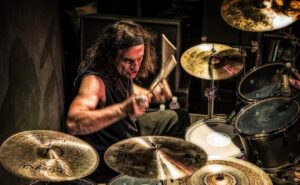
Chelsea joined here by Vinny Appice. How are you doing today?
I’m doing good. You said my name right, too – “Aah-pih-see”.
I did, that’s right, I know the difference. You got the “Aah-pih-see”, you got the “Uh-piece”, and I think your other brother says “Ah-pee-cheh”, I think, right?
That’s right, good memory. That’s right.
I picked the right one, so all good. First off, we are here to talk about Breaking Out of Heaven, the exciting new box set that highlights 2007 through 2009 with Heaven and Hell. So let’s just start off with the idea to compile this box set, and why now was the right time for it?
What? There’s a box set?
There is, a whole slew of things, you’ve got CDs, Blu-ray of your concerts, all kinds of stuff coming out.
Well, you know what’s good about the box set is they put it out, and it’s like the final end of Heaven and Hell era of Black Sabbath with Ronnie and I, because in 2010 it ended sadly. We were supposed to do some more touring in 2010, and that’s when Ronnie was getting treatment and then we thought he was going to be okay, but then it just got…you know, change of plans and it didn’t happen that way. So that was kind of a sad ending, we couldn’t end anything and go out and play or do anything because Ronnie was having an issue, you know? So this is more of a happy ending that, here is all the things we did all in one box set, and it’s a good ending, I think, and a good time for it.
Absolutely, it’s revisiting that amazing music and that amazing era that you guys all made together, and keeping the memory of Ronnie alive, because you’re right, it’s very unfortunate, very saddening, but it’s wonderful that there are so many tributes to Ronnie: events like we were actually just talking about before the call, the way they do Bowl for Ronnie and Rock for Ronnie. There’s always so many memorials and tributes, and there was a documentary, now there’s a box set – it’s wonderful that there are so many ways and approaches to keeping his legacy and memory alive.
Right, right, I mean, he was such a great person and so friendly to everybody, he loved his fans, loved his music, and we all miss him, so this is a great event to put the final closure on the band.
Talk to me about the very first time you met Ronnie James Dio and your first impressions of him.
The first time I met him was when I went down…I met Tony Iommi first in 1980, and I went to the hotel to meet Tony. They said they were looking for a drummer because Bill Ward left the Heaven and Hell tour. So I went down and met Tony, and we hit it off. And the next day Tony said, “Why don’t you come down to rehearsal tomorrow? Bring your drums and let’s see how it goes”. And I did. And it went really well, and that’s the first time I met Ronnie and Geezer and—and Geoff Nicholls. And we played – the first song was “Neon Knights.” It’s the first song I ever played with Ronnie. I heard that on the radio a couple of weeks before, which is kind of weird. Happened to catch it on the radio, and I thought, “Ah, that sounds good, man. The new Sabbath, and Ronnie James Dio’s singing, and I knew the song was easy to play. It’s the tempo, and then there’s a break before the solo. So I thought, well, I can’t possibly mess that up too bad, so let’s play “Neon Knights.” And, uh, ’cause I didn’t really know all these Sabbath songs. I wasn’t a big Sabbath fan.” You know, I listened to more Zeppelin than Sabbath. And so, when we went down to play, I said, “Let’s play Neon Knights.” So we played Neon Knights, and then it went well, I didn’t mess it up or anything. It was sounding really good. Tony liked that I played the actual part that’s on the record, which is the snare drum, that double on the snare. I guess some drummers didn’t play that – why, I don’t know.
It’s prominent in the song.
So that was the first song I played with Ronnie. And then it was the last song on the last show we played at – what was it, in Atlantic City? So that song took me on a journey all the way through.
Definitely, like, full circle.
Full circle, man. It was sometimes it was the opening track, sometimes it was the middle in the set, or it just happened to be at the end of the set, the last song on the last show we did together. So, I think that was really fitting, you know, that that song closed it. Opened it and closed it, you know.
Definitely. A fantastic song to do it, absolutely. That’s great. And I love that you, not only had that attention to detail about the snare hits and the exact rhythm and everything, but that Tony noticed it as well and was like, “Hey, you’re the only one to do that.”
Yeah, Tony noticed that. That’s crazy. But I didn’t—I didn’t find that out until years later. I forgot who told me, somebody told me, “Yeah, Tony liked that you caught that thing that Bill did”, which is pretty easy. It just gives it a little bit more of a hopping-bopping feel, you know? And I heard that Tony liked that. That’s why he really – I caught his attention. Good thing I did that.
I know, right? You were actually paying attention to the record. That’s great. Were your methods of learning drums mostly by ear and by listening to records and imitating what you’re hearing and everything?
Well, it was that, and also I went to drum lessons. You know, my brother played drums. He was 11 years older, Carmine. So I was around that all the time, surrounded by it. So eventually Carmine told my parents, “Hey, he’s getting really good. He should go for drum lessons.” So I went to drum lessons for three years to the same guy that Carmine went to. So I learned how to read. I learned how to go through all these drum books and all this stuff. So you do both. I got that as a foundation, and then listening to music. And there’s a whole art to listening, especially if you’re learning a song, listening to what people play and catch what they’re playing, or don’t get in the way, and different things like that, so.
So you did both.
Both of those things, learning how to play. That’s why I’m deaf now.
Too much drums over the years. You had to listen to your brother for 11 years first, right?
Oh, yeah.
That’s funny. You also frequently have played with your brother, Carmine, over the years. You did The Drum Wars a couple years back. I remember seeing that as well. You guys were both on stage, having a “war” between drums, but actually making amazing music together, any plans to do something similar like that again?
No, no, we did that. We did an album together, which was fun. The shows were good. Unfortunately, we called it Drum Wars, and a lot of the promoters thought it was a drum clinic. They thought it was a drum thing, and it’s not really a drum thing. It was Carmine and I playing a history of our music, and each of us took a little drum solo in the show, of course, and it was a good rock show. So, we did it as much as we could, and then, you know, we just moved on to other things. So, we’re not gonna plan on doing it again. Carmine’s too old now. Don’t tell him… Nah, he still kicks ass.
I was going to say.
He’s gonna be 80 this year, but he’s still kicking ass. I didn’t get older, I stayed the same. Actually, I’ll tell you a secret. What I did was I changed my age to Celsius. This just shifts the whole thing over, right? You get it? Yeah, it’s like, how old are you? I’m 36…Celsius.
Celsius, it’s a good trick, I’ve got to keep that in mind.
You don’t need it yet, you’re young.
*laughs* Well, that’s great. Now honestly, it was great. I did catch the Drum Wars show, and yeah, I know what you mean. I feel like when they see the Appice Brothers together, people are going assume that you’re going to be teaching something, you’re going be kind of doing a drum clinic or instructing, but no, you guys were just there to jam and rock out and play.
Yeah, it was a high-energy show, playing all the hits. I played a lot of Sabbath stuff, and Dio, and he played his stuff with Ozzy, and all this stuff. So, it was a good show, you know? Should’ve called it something else.
No, I think it went over well. I don’t think it mattered what you called it. So while the focus has been on the box set for right now, you’ve also been keeping very busy with Vinny Appice’s Sabbath Knights. So talk to me about getting that band and lineup together.
Yeah, well, this was a lot of fun for me to do, and what it is, is I got a great band, and I got Jim Crean on vocals, who sang in the Drum Wars show with us.
Yes, that’s right.
And he can sing – he loves Ronnie. He swears by Ronnie, and he can sing all the Dio stuff and all Ronnie’s Sabbath stuff without tuning down. I mean, it’s just fantastic. And the rest of the band just kicks ass. It started out as somebody putting a Sabbath Night thing together in Ohio – my friend Mike Carr. He goes, “Would you be interested in coming to play with us? It’s all Sabbath.” I go, “Okay.” So when I did that, I saw the audience was really into hearing all this Sabbath stuff and some Dio, and I thought, you know, it’d be fun to put something together on the side and then go out and do this. So that’s what I did, and I got a great band, and we’re playing some gigs coming up in Chicago, Ohio, upstate New York, and it’s a lot of fun. We play all the great stuff. I get to play some material from the Heaven and Hell albums, like “Children of the Sea,” obviously “Heaven and Hell,” “Neon Knights,” and so on. It’s going well, and it’s a lot of fun, you know? It’s low pressure. We’re not trying to sell albums and all that stuff. We’re not trying to break into the business. This is just a cool show. We’ve got a website. Sabbath Knights with a K.
Sabbath Knights with a K, got you. Reference to “Neon Knights,” which is appropriate given that full circle story you were just telling, too, which I love that. I mean, how did you go about digging into and creating the set list? Were you just thinking about songs like, “Hey, I haven’t played that in a while,” or, “I never really played that one much live,” and just kind of throw them on there?
Well, it kind of went back to what we played even on the Heaven and Hell Tour—there were certain songs – this is 1980 – that we chose to play, like “Neon Knights,” “Children of the Sea,” “Sign of the Southern Cross,” “Mob Rules”—oh no, that’s later on. There were so many songs; it wasn’t a lack of songs, it was which songs are really popular. “Turn Up the Night” – we did a couple of old things too, like “Iron Man,” a little bit of “Iron Man.” We did “War Pigs”, that’s in the set. So it’s a little of everything, so it was easy to choose because it’s like, what’s the most popular songs from every album, you know, put it together. Ah, it definitely—and then make ’em work tempo-wise and key-wise, all that stuff, so it sounds good.
That’s where the three years of drum lessons came back, right?
Yeah, yeah. That was like, Arranging. Arranging, yeah, and writing it down so we don’t forget.
Definitely. No, that’s great. Yeah, I was curious if you had dug into any tracks that you haven’t played in a while or things that you haven’t seen in a while, but it definitely seems to be more of a focus on the popular tracks that everyone expects to hear in a Sabbath night show, which is wonderful.
I know certain songs are fun to play, you know. “Sign of the Southern Cross” is so heavy, “Heaven and Hell” is an anthem, you know, so it’s great. Easy, easy choices to put together a set.
Very cool. So on a different note, you also worked with Joel Hoekstra fairly recently too on his new album From the Fade, so tell me about working on those tracks.
Joel!
Joel, that’s right.
What a great guitar player. Yeah, Joel—he’s on three albums, and I play drums on all three, and so did Tony Franklin. He didn’t play drums; he played bass. You know? And he’s the one that hooked me up with the first record because Joel approached him, and Tony said, “What about, uh, let’s get Vinny Appice to play?” And they called, and Tony’s so great to play with, and we just lock in together. And Joel’s an amazing guitar player, and he writes all the stuff. And he sends me the tracks, they didn’t have all finished vocals, but you know where he’s going with it, so he sends me the tracks, and then I did it here in the studio. *points to drums in back*
There’s the drums! The actual drums played on the Joel Hoekstra record—look at that.
There they are! And actually, that’s the live set, so it’s the Sabbath Knights.
Oh nice, very cool. Tell me a little more about the gear. What do you have back there?
Well, this is a drum company called Sawtooth Drums, and my friend Joe Fuoco – he started the company. They have guitars, basses, they’re really big online. And these are Sawtooth, these are the high-end drums; they’re hickory drums, and they just sound…Big, they’re really warm sounding, great sound, and I’ve been doing some tracks in here for Cleopatra Records. I get on these drums the next day and they sound great. I don’t even have to tune them very much. They’re just really good sounding drums, and so it’s called Sawtooth.
Sawtooth sounds very familiar, and I have a feeling that you played a set at their booth at NAMM a few years back, and if I remember correctly, I think that was the one they shut down for being too loud. Am I right about that?
That’s exactly, every time I played, the sound police would come by. “Oh, you guys gotta…” – I said, ‘Hey, dude, we’re playing Black Sabbath”.
It’s got to have some power to it.
And we’re not at full power, no way. You know, we were trying to keep it level, and every time I played, the guy would come by. He’d come by laughing eventually, like, “Oh, no”.
Like, “This one again?”
So that was the one time. “These guys again?” So that was the one time Sawtooth went to the NAMM show.
Ugh, it was the first time and the last, because after that experience, they’re probably like, ‘Dang, we can’t play anything at all.’ That’s funny.
And then it stopped from COVID after that. So then there was a break and then they decided not to do it again.
Got it. Well, at least it was a very memorable showcase for them, for sure, and I’m pretty sure Rudy Sarzo also showed up, too. I think Robert Sarzo played too. I remember a good amount of rock happening in that booth, so that was a fun one. Non-stop.
It was non-stop. It was the only one that had people just hanging out. There were at least a couple hundred people in front of the stage all the time, because somebody would finish, and then, uh, ‘Oh, Vinny’s here, hey, let’s play some Sabbath, or Dio, okay””, and I get up and play a couple songs. So, it was non-stop; there was like a little rock concert at a rock show. For sure, it was like a kind of a mini jam—it—it was just based on whoever showed up, like, ‘Oh, hey, so-and-so’s here, let’s go, let’s play something else now.’ I’ve been to NAMM a lot, and that was the best time ever as far as musical—it was really cool. Very cool. It’s a shame they didn’t do it again, but I—I understand.
Well, you never know—they might find a way to find their way back at some point.
Yeah.
Have you been back to NAMM lately?
I haven’t been back for a couple years, and then I went this past year. It was interesting to see how empty it was compared to what it used to be. You know, it was one floor. Usually there’s two floors and then an upstairs. This time it was one floor and a couple of people upstairs, companies upstairs. And there was spots on the floor where there was empty. And you can actually walk around. But I remember being there, bumping into people – so, so many people.
It was still pretty busy, I think, in terms of crowds, but I agree, the booths were a little more spread out, a little more sparse, not quite as many companies as probably pre-2020 used to come to NAMM, but still a really good, grand-scale event, nonetheless.
Because I’m comparing it to when it was in its heyday, you know. That’s the last time, before COVID and all that. But I enjoyed going. It was fun to see whoever was there and check it out. A lot of fans there now, so.
Definitely. So you’re also part of the Rock ’n’ Roll Fantasy Camp a couple times this year coming up, one in Miami, one in Hollywood. When did you first get involved with those events, and just the Fantasy Camp in general?
I heard about the Fantasy Camp, like, I think it was 2010 or ’09, and I thought, “I want to check this out. Sounds very interesting”. So I met David Fischof in 2010, and I said, “I’d love to be at a camp,” and he goes, “Oh, okay, that’s great.” And David’s a great guy, he’s a smart guy, and he loves music. So he put me in a camp, and it was cool. He then invited me back to camp after camp after camp, and now, I’m not on the road, really, so my schedule’s a little more free, so I’ve been doing a lot of these rock fantasy camps. The next one coming up is with Roger Daltrey of The Who, and that’s in Florida. Then we got Tommy Lee in May in Hollywood, and we just finished Stuart Copeland in Hollywood, too. So it’s really great. It’s a fun thing to do. It’s creative and it’s unusual, than just going on the road with a band and rehearsing and playing. Here we get the jams. There’s a jam night. You know, we jam with some of the people that arrive, they’re called campers. And it’s a lot of fun. So the next one’s Roger Daltrey, and then they’re always booking more and more, so we’ll see who’s next. But I love doing it. It’s a fantastic thing.
Very cool. No, it definitely is a lot of fun. I agree, it’s different than rehearsing and performing a specific set. It kind of is just like a grand-scale Jam Night, where the unpredictability is part of the fun.
Yeah, yeah, you never know what’s gonna happen. Sometimes I’ll have to play drums in the band. See, I’m in charge of the band. The way it works, people – the campers – they join the camp and then they put you in bands. So you get in the band and everybody’s complete, or you get in the band and there’s no drummer. So you’re like “okay, I’ve got to play drums in this”.
Oh, okay, you’ve got to step in from time to time. I get it.
Yeah, I like it when I don’t have to play. It’s easier – going to hang back and watch, unless the band’s real good. Yeah, but it’s a lot of fun. We all have fun; I make sure my band has a good time. And then you get to play the Whiskey and the Viper Room in Hollywood, one show, and then you get to play with Roger Daltrey, or Tommy Lee, or Stu Copeland. You get to take pictures with them, so it’s a real cool thing, you know.
I love that they cover a good range of rock and metal music, too, because sometimes it leans a little more classic rock, sometimes it leans a little more metal, sometimes, like the Sunset Strip one – they have this little more ’80s hard rock kind of vibe, so it’s good that there’s a good range of music covered, too.
That’s right. We did one where, I was able to get Tony Iommi to do one, and people were freaking out.
I’m sure, yeah. Rare appearance.
But I was with Tony, I told him what was going to happen and here’s what we’re doing, and so that was cool. So I was able to guide him through, you know. But people loved it.
They loved it. Very cool. Now, another show that we’ve seen you play over the years is, of course, Last in Line. Is there any news on the Last in Line front?
Last in Line, well, Viv has been busy with Def Leppard, and we had since parted ways with singer Andy Freeman, and we’re in the process of checking out some new singers. And then putting a next album together. We’ve got a deal sitting there, and so we’re looking for singers. So we got a couple people that we’re talking to, and we’ll see what happens.
Very cool, that’s great. So other than that, what else is on the horizon for you right now?
I’m gonna go to the grocery store in a little bit.
Okay, exciting, good stuff *laughs*
Nah, there’s not…I’m just glad we’re not flying this month because the TSA lines are ridiculous. And it’s like, arrive three hours before. You mean you want me to stand on line three hours? So next month, hopefully it’ll get better. No, but that’s what’s going on. I’ve been doing a lot of sessions with, I think I mentioned it before, with Cleopatra Records. They do all different projects. They did something with a Fleetwood Mac song, but heavy. Because they said, “You wanna play on this?” I went, “Let me hear it.” And I heard it, and I went, “It’s really good.” So it’s unusual for me to play a song like that, but it was totally different, you know?
Yeah, you get to put your own style into it, too, which is cool.
Oh yeah, they let me do anything I want, so it’s really cool.
That’s the best setup, actually.
I like doing this. It’s fun doing this because you can switch snare drums, you can switch mics, I can – I do everything myself. That snare drum that’s over there, that snare drum is what I recorded “Mob Rules” on.
Oh, very cool!
But it’s got the wrong head on it, because I thought, let me try that snare drum, and I put it up, and it was a little different sounding than I thought, so I got to put another head on it. But that’s actually one of the drums floating around from, God, the ’80s.
Well, that’s good you held on to it, and then the fact that you can still kind of play around with it, get different sounds out of it, switch it out, and it’s still that same “Mob Rules” drum, which is very cool.
Well, what happens with those drums, they’re Ludwig, a chrome Ludwig, and even when we recorded Mob Rules, what happens is you’re playing, and the lugs start slipping loose, the screws. So the tone of the snare drum goes down as the screws loosen. I don’t know if you could hear – I never really checked the “Mob Rules” to see if the note has changed.
Well, now I’m going to go listen for that. I’ve got to find out now.
I’ve never noticed it, but finish the song, you go, “Oh man, this one lug is really – the screw is loose”. Then you tune it back up and it goes back higher. So now what I do is – drummer tip: Loctite. Loctite is a thing you put on screws, let it sit for a minute, and it locks it in. So you could still break the seal, but it won’t drop down now. But I didn’t know of that stuff back then when we were doing “Mob Rules”. And it’s a great drum, you know, and I’ve got to put the other head on it, and then I’ll try it again and see what happens, but Loctite.
And then you’ll play Mob Rules and see if the tone goes down.
Yeah, yeah, I gotta listen to that and see if the tone did go down. It probably went down a little bit, so…
If it did, it probably was so subtle that only you would be able to hear it if that happened.
I know, I know, I would too. I hear all these subtle…even though I’m half deaf from playing this stuff for a long time, I hear all the notes, I hear when people are out of tune, people singing off key or keys, I hear all that stuff.
Well, you’ve got the musician’s ear, that’s why.
Yeah, but I can’t hear people in conversation that well.
That’s not as important as the music. You don’t need that part, just the music—that’s all that matters *laugh*
Yeah, just go, “yeah, yeah, yeah, Okay, thank you”.
So is this your home studio [in the background], I assume?
Yeah, this is it, and I only record drums here, I never had anybody…actually, I had one guy come down, Erik Turner from Warrant, because he used to live close by. And he came down, and we were jamming on some songs, and I recorded the guitar, but I’m not set up for that.
Got it, it’s exclusively a drum studio. Well, at what point in your career did you start getting into the recording and production side of things, or when did you start learning to do that?
That’s a good question. When did I start doing this? Probably in this house, so 2013. So all my other houses where I lived, I never really set up drums. I had electronic drums, but I didn’t set up drums. And then when I moved into this house, this is in California, it’s a big house and this is a perfect room. So I set the drums up and then let me, “okay, how do I record”, sort of from the beginning, you know, “how do I do this, how do I do that”? And I had some friends guide me through, and now I got it down, you know, it’s perfect. I’m not a whiz. Sometimes I don’t know exactly what I’m doing, but the drums sound good. The whole trick to recording any instrument is to know what you want to sound like. You know, a lot of drummers will just tune the drums as much as they can and put them in the room, record, or, if it’s new drums, they take them out of the box and they just play. No, you’ve got to tune them. You gotta work with your instrument and learn, eventually you’ll learn what you wanna sound like. I know what I wanna sound like. I want, you know, the bass drum to shake the room, you know – boom! And the snare drum right here, and all the toms, and so I know what I wanna hear, and that’s the whole trick, ’cause once you got that in your head, you can go for that sound. Now I’ve got a couple of room mics and different things here. There’s a mic on the bass drum. That’s a sub mic. What that does is get a lot of low end. So when you’ve got a kick mic inside the bass drum and then you got that attack, you put the sub mic in and it gives it those low ends. It makes it sound really big. Extra resonant, extra big rim sound, all that.
That’s awesome. This was an in-depth look at the gear of Vinny Appice, some of your secrets here. I love it.
Well, you know, in the Zeppelin, I don’t know if it was the movie or the book, Jimmy Page, they used to cut the speaker, rip the speaker cone in the amplifier to get distortion. That’s how they got distortion back then. Like, this is way back. And then that eventually led to generating that kind of fuzzy dirt distortion sound into pedal boards and stuff, you know.
For sure. So much of music and audio engineering and recording is honestly just experimenting. You’re just like, “Let’s try this, see how it goes,” and then it ends up sounding great, and other people start imitating it, and that’s how the trends get started.
Yeah, try everything. You think it’s crazy things, and, you know, see what happens. Might sound great.
Exactly. Well, awesome. Well, this has been great spending time getting to know more about you, your gear, your background in music a little bit more than we knew before, and also what you have going on with Sabbath Knights. So, thank you so much for your time today. Again, we’re focused on Breaking Out of Heaven, the box set from Heaven and Hell coming out soon, and we’ll keep an eye out on the road for Vinny Appice’s Sabbath Knights.
Right on. Thank you so much, Chelsea. Good to see you, good to talk to you. Bye, everybody.